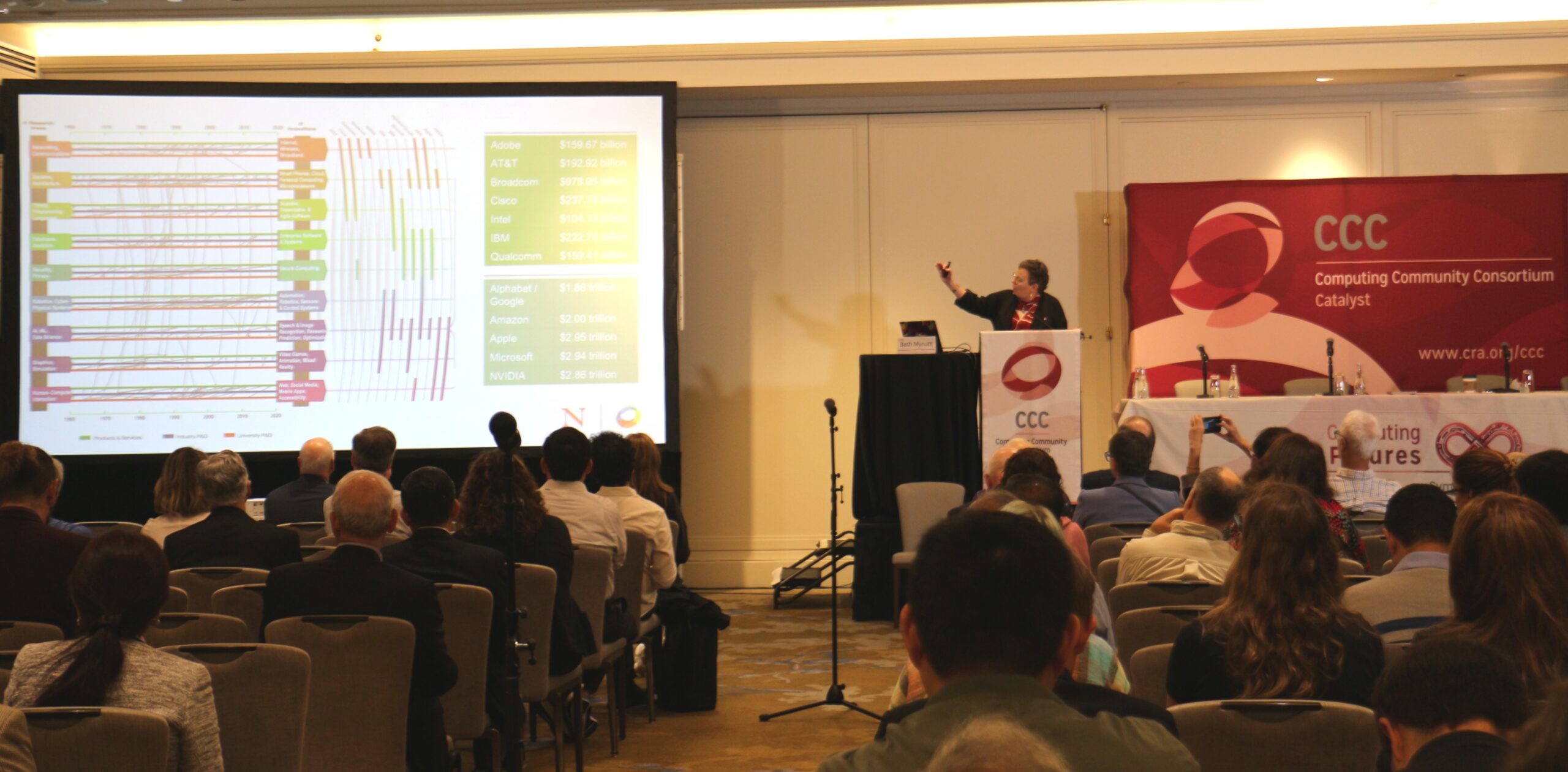
Beth Mynatt, Dean of the Khoury College of Computer Sciences at Northeastern University, recently delivered a compelling keynote at the CCC Computing Futures Symposium that underscored the often-overlooked yet profound impact of federally funded computer science research. She began with thought-provoking “what if” scenarios, inviting us to imagine a world without key computational advancements rooted in decades of federal investments. What if the internet hadn’t emerged from US-backed research? If computational innovations hadn’t driven a significant reduction in cancer mortality, saving millions of lives and trillions in economic impact? Or if IT-driven innovations hadn’t revolutionized agriculture and today’s crop yields were 50 percent lower across the world? These hypotheticals vividly illustrated the fundamental role of long-term, foundational research.
Mynatt then introduced the concept of “tire tracks,” a series of reports documenting how public investment in university research translates into massive economic returns. The latest 2020 National Academies of Engineering report, which she chaired, systematically showcases the flow of people and ideas from academia to industry, leading to innovative products and services. This framework highlights “resurgence” — where seemingly dormant research areas like AI blossom into economic powerhouses — and “confluence,” where IT innovations merge with other sectors such as healthcare and agriculture to create transformative change.
The updated “tire tracks” diagram visually represents this intricate web of influence. More than 800 data points illustrate how academic research feeds into industrial innovation, leading to companies with over a trillion dollars in annual revenue. This impact extends far beyond the tech sector, influencing industries critical to our economic prosperity.
Mynatt emphasized that universities act as “time machines,” venturing into speculative futures that commercial entities, with their short-term incentives, cannot. The free movement of faculty and students, carrying ideas and expertise, is another vital, albeit often unquantified, driver of innovation. This unique synergy between academic freedom and industrial application forms a virtuous cycle, fueled by initial federal investment.
The core message is clear: continued federal investment in fundamental computer science research is not just beneficial — it’s crucial. It’s not about predicting the next big thing, but about fostering an environment where seemingly disparate research topics can converge to create unforeseen, powerful transformations. This sustained investment is vital not only for groundbreaking ideas but also for nurturing a skilled labor force capable of driving future innovations.
Mynatt’s keynote served as a powerful reminder of the deep, often invisible, connections between public research funding and the technologies that underpin our modern world. It’s a compelling argument for continued support of the unique ecosystem that has generated trillions in economic impact and profoundly improved society. Stay tuned for a full recording of this keynote which will be released in the coming weeks.