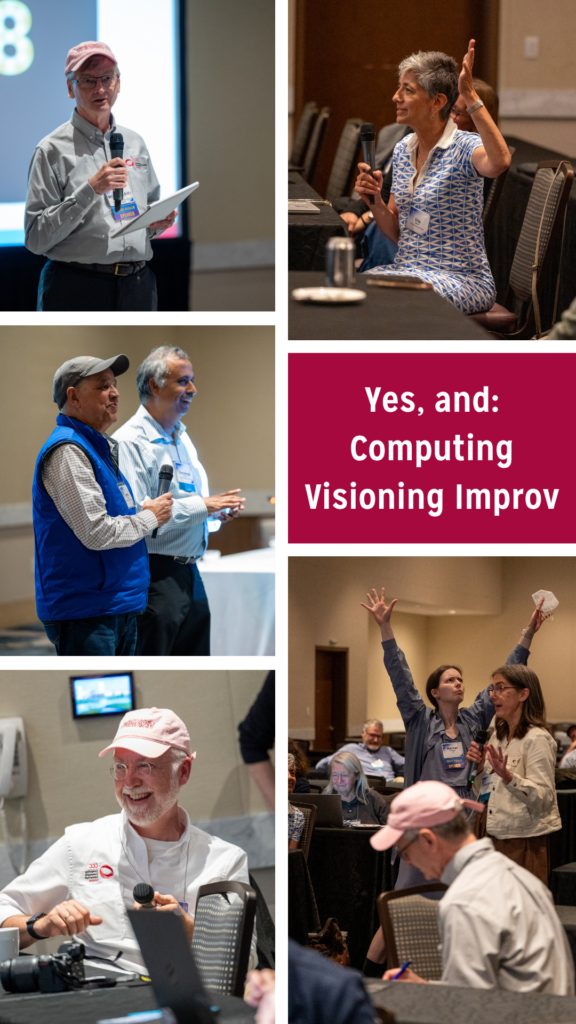
 Last week at the CRA Summit in Prior Lake, MN, members of the CCC Council Executive Committee hosted Yes, and: Computing Visioning Improv, a session that swapped the usual panel format for visioning improvisation. The session ran on Thursday, July 23rd, and drew 57 participants willing to think on their feet.
The format of the session was built around a card game CCC developed for this kind of brainstorming called Speculative Execution. In small teams, participants drew from two decks: one featuring computing substrates like quantum or biological computing, and one featuring application domains ripe for transformation, from agriculture to email. Each team combined whatever cards they drew and pitched a vision for how that substrate could address a real problem in the application, with the crowd serving as both audience and judge.
Speculative Execution Winners
The session did what it set out to do. It produced out-of-the-box ideas that might not fit neatly into a grant proposal, brought researchers from different fields into direct conversation, and generated a fair amount of fun along the way. But across the two rounds, two particular pitches stood out.
Round one went to Carla Brodley (Northeastern University), Rachel Pottinger (University of British Columbia), Alan Marchiori (Bucknell University), and Christine Julien (Virginia Tech), whose pitch imagined a rapid response temporary robot pothole filler. Their team proposed autonomous units that could deploy to fill potholes on a temporary basis, buying time and improving safety until permanent repairs by humans could be scheduled. The substrate they chose was Robotics, and the application they wanted to improve was Infrastructure Maintenance.
Round two went to Zachary Tatlock (University of Washington), Casey Deccio (Brigham Young University), Stefan Andrei (Cleveland State University), Jen Markoff (University of Washington), and Antony Hosking (The Australian National University), who pitched executable email. Their concept turned email from something to be sorted through into something where only the most relevant messages to you would be sendable. Their substrate of choice was Heterogeneous Computing, with an application to Email.
Both pitches captured what the session was after: unlikely combinations that push researchers to think in long-term, unfamiliar directions.
Download the Game
Want to try the game with your own computing department? The card game, Speculative Execution, is available as a PDF here. The PDF includes instructions for gameplay as well as guidance for teams as they develop the pitches for their ideas.
Tune in to the CCC LinkedIn Showcase Page for updates like this. Stay connected with CCC for the latest insights, publications, and opportunities to engage by subscribing here.