The Computing Community Consortium’s (CCC) latest report, Computing on the Fly: Navigating a Vision for the Future of Drone Computing, presents the far-reaching potential of non-military drone infrastructure, from ecological management to supply chain support to boosting agricultural efficiency to recording life’s most important moments. This is potential that can be realized by 2035, the new report asserts, presenting a roadmap for how to make it so.
Key Challenges in Advancing Drone Computing
The report identifies twelve key technical challenges in which drone computing must advance in order to support drones as part of our national infrastructure in the next ten years. These areas include: 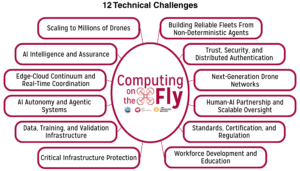
- Scaling to millions of drones
- AI intelligence and assurance
- Edge-cloud continuum and real-time coordination
- AI autonomy and agentic systems
- Data, training, and validation infrastructure
- Critical infrastructure protection
- Building reliable fleets from non-deterministic agents
- Trust, security, and distributed authentication
- Next-generation drone networks
- Human-AI partnership and scalable insight
- Standards, certification, and regulation
- Workforce development and education
Critical Paths for Researchers
Academia plays a critical role in many of these challenges. The following are key computing milestones identified for the next decade to maximize the impact of non-military drones:
- Create simulation-to-reality pipelines that help bridge the sim-to-real gap
- Establish integration testbeds (physical + digital) supporting graduated complexity, realistic failure injection, and shared milestones for reproducible research
- Establish scalable and performant drone-based entity tags and key infrastructure for identification and tracking at device level
- Develop real-time-aware autonomy frameworks enabling analyzable composition and runtime adaptation and allowing drones and edge nodes to negotiate sensing rates, model fidelity, and control frequencies under enforced safety constraints and predictable timing guarantees
Alongside industry, funding, and policy recommendations to reach these milestones, the report outlines necessary shifts and advancements specifically for researchers to help reach the 2035 vision:
- Break disciplinary silos to address the systems integration talent gap
- Fewer than a dozen graduate programs currently produce engineers with combined AI-aerospace-security expertise
- Autonomous drone research demands collaboration between traditionally separated communities in robotics, networking, AI, security, and human-computer interaction
- Engage with real deployments to understand practical constraints
- In particular, the labor shortage in aviation and infrastructure inspection creates immediate demand for autonomous solutions
- Share datasets and frameworks to accelerate collective progress and avoid duplicative effort across institutions
Read the Full Report
The findings of the report are informed by discussions at the CCC Computing on the Fly visioning workshop held December 1-2, 2025 in Washington, D.C. — generously supported by the National Science Foundation (NSF) and IEEE Computer Society — which convened 47 cross-sector experts to articulate a vision for drone development. These discussions resulted in the final Computing on the Fly: Navigating a Vision for the Future of Drone Computing report, authored by Kevin Butler (University of Florida), Christopher Stewart (The Ohio State University), Nils Aschenbruck (Osnabrück University), Weisong Shi (University of Delaware), Ufuk Topcu (University of Texas), and Deborah Silver (Rutgers University).
We encourage all members of the computing research community to read the full report at the link below.
Read the Full Report Here
Tune in to the CCC LinkedIn Showcase Page for updates and more reports like this. Stay connected with CCC for the latest insights, publications, and opportunities to engage by subscribing here.