By Matt Hazenbush, Director of Communications and Member Engagement
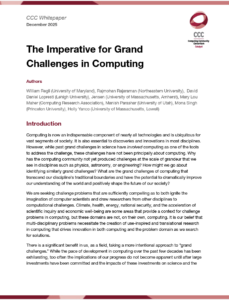 Despite computing’s central role in modern science, industry, and society, the field has not yet defined computing-specific grand challenges that can focus research, articulate shared ambitions, and catalyze progress at scale. A new CCC white paper, The Imperative for Grand Challenges in Computing, argues that the maturity and influence of computing now demand a deliberate effort to identify such challenges — and that doing so will shape the next generation of discoveries in our field.
Computing has repeatedly transformed how the world learns, works, communicates, and innovates. Yet while other disciplines have long used grand challenges to unify research communities around ambitious and measurable goals, computing’s most significant advances have often emerged without a field-wide framework or intentional long-term strategy. The authors contend that this is a missed opportunity: computing should not only support other disciplines’ grand challenges; it should articulate grand challenges of its own.
This paper — authored by William Regli, Rajmohan Rajaraman, Daniel Lopresti, David Jensen, Mary Lou Maher, Manish Parashar, Mona Singh, and Holly Yanco — makes the case that now is the time to define such challenges. Doing so will help the field take a long view, guide translational impact, and build the research structures necessary to address the profound transformations underway as society increasingly relies on computational systems.
Why Grand Challenges — and Why Now?
The white paper argues that computing is in the midst of a major societal transition: our systems, institutions, and scientific practices increasingly run on computational substrates. Despite this, computer science has not defined grand-scale research questions commensurate with the field’s growing responsibility and potential to drive transformational change.
Grand challenges offer a mechanism to:
- Focus the community’s attention on ambitious, high-impact research goals
- Align computing innovations with pressing societal needs
- Provide a shared framework for long-term progress
- Clarify desired outcomes and impacts
- Engage interdisciplinary partners around computational advances
The authors note that the pace of progress in computing can obscure the need for intentional direction. Breakthroughs often appear sudden, but many emerged from decades of foundational, use-inspired, and translational work that only later reached critical tipping points. A long-term, challenge-driven mindset can help the field recognize and shape those trajectories earlier.
Learning from History — Inside and Outside of Computing
To contextualize the need for computing-specific grand challenges, the paper surveys examples from science and engineering: Hilbert’s Problems, the Longitude Act, the Human Genome Project, the Apollo Program, and several federal “moonshots.” These efforts illustrate how grand challenges can mobilize researchers, drive infrastructure development, and create clarity around ambitious but measurable goals.
The paper also reviews historical examples within computing:
- DARPA’s Strategic Computing Initiative
- DARPA Grand Challenges in autonomous systems
- CRA’s 2002 and 2003 grand challenges conferences
- The recent 20-year retrospective examining why many early challenges remain unresolved
These experiences highlight both successes and challenges, including the need for specificity, measurable progress indicators, and a deep understanding of application domains. They also illustrate how computing revolutions often result from contributions across many organizations and subfields—not from isolated breakthroughs.
Toward a Framework for Grand Challenges in Computing
To help the community define future challenges, the authors propose five criteria that a compelling grand challenge should meet:
- Impact: Address a critical need or urgent societal problem
- Ambition: Push beyond current computing capabilities
- Feasibility: Be just barely achievable with emerging ideas
- Interdisciplinarity: Draw on expertise across computing and other fields
- Measurability: Allow progress to be meaningfully assessed
The framework is designed to support grand challenges that reflect computing’s unique scale, complexity, and role in society.
Drawing on CCC roundtables, the CRA Summit, and discussions with early-career researchers, the paper identifies several broad thematic vectors that recur across the community’s thinking, including:
- Advances in computational abstraction
- New models of computation (e.g., qubits, photons, neurons, chemicals)
- Improved modeling and simulation capabilities
- Sense-and-act systems and robotics
- The role of AI in design, discovery, and cognition
- Human–machine symbiosis
- Trust, transparency, and security in computational systems
These vectors are not grand challenges themselves. Instead, they represent promising directions from which specific, audacious challenge problems may emerge.
A Call to Action
The authors emphasize that identifying the next grand challenges in computing must be a community-wide effort. Grand challenges are most powerful when they reflect a wide range of perspectives, expertise, and motivations across the research ecosystem.
The CCC encourages computing researchers to help advance this process by:
- Participating in CCC discussions on LinkedIn
- Proposing a CCC Blue Sky Ideas Track for a leading conference
- Submitting a CCC Visioning Workshop proposal
- Nominate yourself or a colleague to join the CCC Council and contribute directly to long-term community visioning
- Engaging colleagues, students, and collaborators in conversations about what the grand challenges of computing should be — and sharing those discussions with CCC
Grand challenges have shaped eras of scientific progress. As computing continues to transform both science and society, the field now has an opportunity — and a responsibility — to define the ambitious questions that will drive the next decade of innovation.
To dive deeper into the ideas and motivation behind this community-wide effort, we invite you to read the full white paper, The Imperative for Grand Challenges in Computing.