In a new workshop report published by the Computing Community Consortium (CCC), Computing on the Fly: Navigating a Vision for the Future of Drone Computing, experts across academia, industry, and government assess the potential of AI-powered drones for non-military use by 2035 and identify the critical barriers standing between today’s capabilities and that future.
The report envisions a decade in which drones move goods, medical supplies, and information at a scale comparable to national infrastructure investments like highways and the electric grid. Potential applications include natural disaster detection drones that spot wildfire sources within minutes, medical supply chains that bypass ground congestion to reach rural hospitals, and nationwide fleets that continuously inspect bridges and power lines. Realizing this future, however, requires closing what report authors call a “capability gap,” where hardware and aspirations are outpacing the software and systems needed to operate safely at scale.
The lead authors of this report are Kevin Butler (University of Florida), Christopher Stewart (The Ohio State University), Nils Aschenbruck (Osnabrück University), Weisong Shi (University of Delaware), Ufuk Topcu (University of Texas), and Deborah Silver (Rutgers University). The findings are a result of discussions at the CCC Computing on the Fly visioning workshop held December 1-2, 2025 in Washington, D.C. — generously supported by the National Science Foundation (NSF) and IEEE Computer Society — which convened 47 cross-sector experts to articulate a vision for drone development over the next ten years.
Core Challenges
The report identifies twelve technical challenges that must be addressed to realize the transformative potential of drone technology:
- Scaling to millions of drones
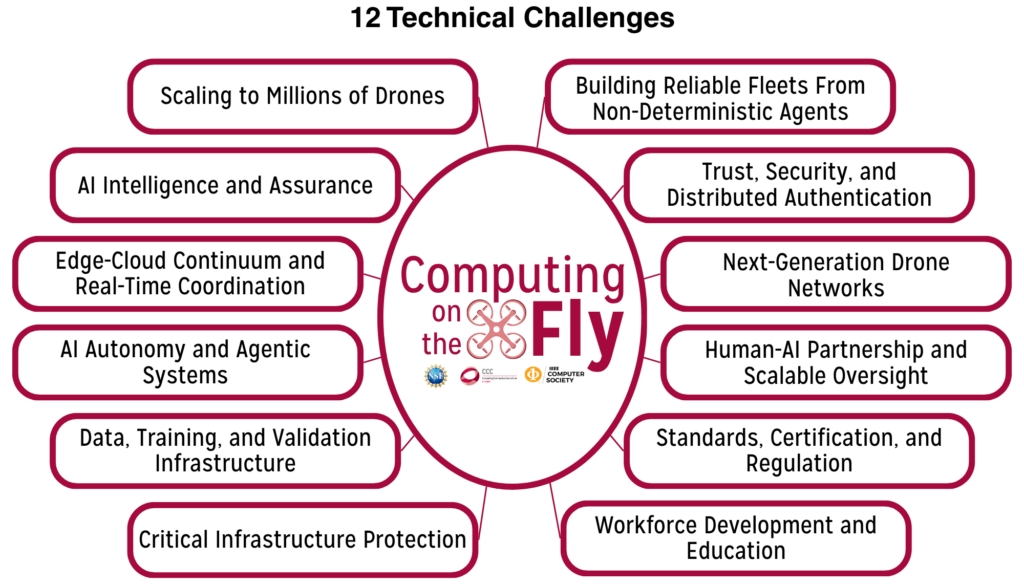
- AI intelligence and assurance
- Edge-cloud continuum and real-time coordination
- AI autonomy and agentic systems
- Data, training, and validation infrastructure
- Critical infrastructure protection
- Building reliable fleets from non-deterministic agents
- Trust, security, and distributed authentication
- Next-generation drone networks
- Human-AI partnership and scalable insight
- Standards, certification, and regulation
- Workforce development and education
These twelve challenges and proposed approaches to them form the basis of the report, laying out a multifaceted path forward for the evolution of done technology.
A Roadmap to 2035
The report also outlines specific technical milestones that represent the minimum progress needed to reach the 2035 vision. These milestones include:
- Creating simulation-to-reality pipelines to bridge the sim-to-real gap
- Establishing integration testbeds to make research more reproducible
- Establishing scalable and performant drone-based entity tags and key infrastructure
- Developing real-time-aware autonomy frameworks to help drones and edge nodes conform to safety constraints and predictable timing guarantees
Reaching these milestones requires effort from broad members of the computing research community. The report provides the following key actionable recommendations for stakeholders like funders, researchers, policymakers, and industry:
- Research funders should coordinate federal investment, establish a national testbed consortium, and target the first 1,000 drone demonstration by 2028.
- Researchers should break disciplinary silos across robotics, networking, AI, and security, engage with real deployments, share datasets, and build interdisciplinary graduate programs.
- Policymakers should adopt open standards, participate in testbeds, share failure-mode learnings, and fund workforce development efforts.
- Industry should adopt proactive frameworks across Actor, System, and Infrastructure pillars, launch regulatory sandboxes, and coordinate internationally to preserve U.S. leadership.
Read the Full Report
The Computing on the Fly: Navigating a Vision for the Future of Drone Computing report is available now. It gives a detailed assessment of the challenges ahead and clear, actionable steps toward safe, scalable drone operations.
We encourage all members of the computing community to read the full report here.
Tune in to the CCC LinkedIn Showcase Page for updates and more reports like this. Stay connected with CCC for the latest insights, publications, and opportunities to engage by subscribing here.