 The efforts of citizen scientists have enabled research projects across scientific disciplines. From users mapping biodiversity on iNaturalist to analyzing protein folding configurations to advance drug discovery on Foldit, we have seen the value of engaging everyday participants in research projects. At the same time, advanced computing outputs like artificial intelligence (AI) haven developed rapidly, becoming applicable across a wide variety of domains. Yet those very developments cannot be sustained without opportunities for participatory research into trust, access, and security — opportunities that citizen science research provides.
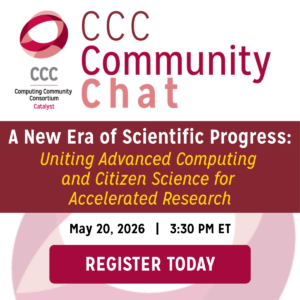
Join us for the second-ever CCC Community Chat: A New Era of Scientific Progress: Uniting Advanced Computing and Citizen Science for Accelerated Research. During this 45-minute webinar, the authors of the CCC Grand Challenges for the Convergence of Citizen Science and Computing Research report will address the strategic value of bringing citizen science research and advanced computing together and how the two might mutually enrich each other. This large-scale convergence promises enhanced results for both disciplines and has the potential to fundamentally reshape how we conduct scientific research. In doing so, it could usher in a new era of scientific progress.
Join for a Live Q&A with the Report’s Authors and Guest Marc Kuchner (NASA)
For this special event, we’re excited to announce guest speaker Marc Kuchner, Citizen Science Officer at NASA. He will join the webinar for a short lightning talk on the citizen science projects underway at NASA that are enhancing our understanding of the universe.
Our second lightning talk will be given by Tanya Berger-Wolf (The Ohio State University), also a lead author on the report. Tanya will present about how computing research converges with citizen science research in conservation biology projects.
Hear key findings from the report, including:
- Critical opportunities for human-centered computing research
- The ways technologies like AI and drones can augment citizen science projects
- How convergence is key to addressing pressing national priorities
- What infrastructural changes are needed to make large-scale convergence happen
At the end of the webinar, Marc and Tanya, along with the report’s other lead authors — including Lucy Fortson (University of Minnesota), Lea Shanley (International Computer Science Institute and GNIES, University of Wisconsin-Madison), Kevin Crowston (Syracuse University), Corey Jackson (University of Wisconsin-Madison), Saiph Savage (Northeastern University) — will be happy to answer any questions during a live Q&A.
Register Now!
Event Date: Wednesday, May 20, 2026
Event Time: 3:30pm ET
We hope you will join us for this amazing opportunity to delve deeper into the future of human-centered computing. Please use the link below to register for the webinar, and feel free to submit some questions ahead of time.
Register Here
Tune in to the CCC LinkedIn Showcase Page for updates and more Community Chats like this. Stay connected with CCC for the latest insights, publications, and opportunities to engage by subscribing here.