Computing on the Fly: Navigating a Vision for the Future of Drone Computing, the Computing Community Consortium’s (CCC) latest report, presents the benefits of advancing the United States’s non-military drone infrastructure, with numerous potential benefits to industry. Drones have the capacity to provide large-scale support to supply chains (particularly rural routes), for example, as well as revolutionize agricultural efficiency. By 2035, these benefits can be made tangible. Computing on the Fly also goes one stop further, laying out the exact ways to make this happen. Below, find a summary of the ways current industry efforts can advance non-military drone computing.
Key Challenges in Advancing Drone Computing
The report identifies twelve key technical challenges encompassing the ways in which drone computing must advance to reach its fullest potential in the next ten years. These areas include: 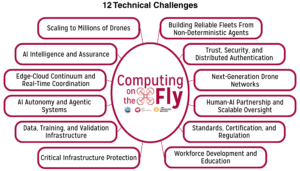
- Scaling to millions of drones
- AI intelligence and assurance
- Edge-cloud continuum and real-time coordination
- AI autonomy and agentic systems
- Data, training, and validation infrastructure
- Critical infrastructure protection
- Building reliable fleets from non-deterministic agents
- Trust, security, and distributed authentication
- Next-generation drone networks
- Human-AI partnership and scalable insight
- Standards, certification, and regulation
- Workforce development and education
The Role of Industry
The specific ways these challenges can be addressed are then outlined in several computing milestones to be completed by 2035:
- Create simulation-to-reality pipelines that help bridge the sim-to-real gap
- Establish integration testbeds (physical + digital) supporting graduated complexity, realistic failure injection, and shared milestones for reproducible research
- Establish scalable and performant drone-based entity tags and key infrastructure for identification and tracking at device level
- Develop real-time-aware autonomy frameworks enabling analyzable composition and runtime adaptation and allowing drones and edge nodes to negotiate sensing rates, model fidelity, and control frequencies under enforced safety constraints and predictable timing guarantees
Industry plays a critical role in advancing these milestones — and, crucially, in maintaining U.S. technological leadership in the area of autonomous systems broadly. Below, see the report’s specific recommendations:
- Launch regulatory sandboxes
Precedents in the wireless and automotive sectors show that standards for interoperability could reduce integration costs by 40-60%. They would both speed up the time-to-market as well as allow smaller companies to participate. Working with policymakers, industry also must commit to end-to-end pipelines for the development, deployment, and low-cost operation of drones.
- Participate in testbed consortia
Doing so would validate approaches on real hardware and influence standards development.
- Share integration experiences and failure mode learnings
This information would inform research directions and prevent others from repeating costly mistakes.
- Invest in workforce development
This future requires interdisciplinary systems engineers. Partnering with universities can help make sure graduates have essential skills for industry participation in this emerging area.
- Expand domestic commercial drone manufacturing and coordinate internationally to preserve U.S. leadership
Few U.S. companies produce commercial drones capable of executing the advanced technologies outlined in the report. Expanding domestic manufacturing capacity would strengthen supply chain resilience, address concerns around sovereignty, and enable rapid iteration and learning that is essential for a competitive advantage. To that end, U.S. industry participation is essential to maintain technological leadership as international competitors aggressively pursue autonomous systems markets, especially in Asia and Europe where regulatory experimentation is advancing rapidly.
Read the Full Report
The full report, including the in-depth explanation and rationale for these recommendations, is available below. We encourage all members of the computing community to read it.
Read the Report Here
Tune in to the CCC LinkedIn Showcase Page for updates and more reports like this. Stay connected with CCC for the latest insights, publications, and opportunities to engage by subscribing here.