In early July, the Computing Community Consortium (CCC) released its very first Call for Innovative Research Visions (CIRV). This call was intended to surface some of the most visionary computing research happening today, within both academic and industry environments. The input CCC received from the computing research community showed what the community sees as important, where time and energy is being focused, and what projects researchers are proudest of. Below, discover three of the most visionary projects submitted to CIRV.
Selected Research Projects
Computational Animal Communication
 Led by Kenny Q. Zhu, University of Texas at Arlington
Recent advances in self-supervised learning, multimodal foundation models, and web-scale data collection create an unprecedented opportunity to transform this landscape. The Arlington Computational Linguistics Lab at the University of Texas at Arlington is pioneering a new computational paradigm for decoding animal communication from large-scale, minimally annotated multimodal data. Initial studies of domestic dogs and cats suggest that their vocalizations contain discrete acoustic units and reusable patterns that encode behavioral, social, and environmental context, challenging the traditional view that animal vocalizations are largely holistic signals.
This vision extends far beyond understanding companion animals. It seeks to establish Computational Animal Communication as a new interdisciplinary field that develops general computational theories, algorithms, and foundation models for discovering, representing, and interpreting communication systems across species. Such advances could transform animal welfare, conservation, and human-animal interaction while providing a unique window into the evolution of intelligence and communication. More broadly, uncovering alternative computational principles underlying biological communication may inspire fundamentally new paradigms for artificial intelligence that complement language-centric approaches and expand the foundations of intelligent systems.
Punishing Agents

Led by Maria Gini, University of Minnesota
What do you do when an agent cannot be trusted? Expel it from the group? Put it in a prison? None of the methods human societies use seems to be appropriate for agents. If an agent is removed, another can be created to replace it. Same if an agent is put in a prison. Unless the method used to create agents guarantees that only collaborative agents will be created and/or will be selected, it does not seem to be possible to guarantee that no agent will be able to infiltrate the group.
Attempts have been made to have conventions for agents that negotiate on tasks to do, but they do not work for all types of tasks. The impact on societies of agents of rewards and punishments has been studied showing that they do not work. Reputation seems to be more useful to foster social behavior.
Will things be different for physical agents (i.e., robots)? It is much easier to control a physical agent, take it out of a group, and replace it with a new agent that has been tested for compliance with the rules. Much more research is needed.
Emerging Technologies: Digital Accessibility
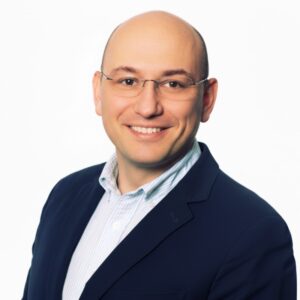
Led by Vlad Roznyatovskiy, Samsung Research America
This research initiative proposes a systems-oriented agenda for accessibility spanning hardware, operating systems, programming tools, artificial intelligence, security, and human–computer interaction. Its central goal is to develop computing systems that can adapt to differences in sensory, motor, cognitive, linguistic, and situational ability without requiring users to conform to a single assumed mode of interaction. Rather than treating accessibility as a downstream interface problem, the initiative will investigate how accessibility requirements can be embedded into system architectures, data models, development frameworks, evaluation methods, and procurement standards from the outset.
A major focus will be the relationship between accessibility and language inclusion. Interfaces centered on written English, conventional keyboards, and standardized commands exclude not only people with disabilities, but also users across languages, literacy levels, dialects, and cultural contexts. Multimodal systems that combine speech, gesture, vision, symbols, translation, personalization, and context-sensitive assistance can reduce both disability-related and linguistic barriers. In this sense, accessibility research offers a pathway toward computing that is less English-dominant, more adaptable, and more globally usable.
The initiative will pursue new interaction techniques, adaptive and multimodal system architectures, accessibility-aware software engineering tools, community-governed datasets, and evaluation frameworks that measure real-world task completion across diverse populations. By positioning accessibility as a driver of foundational computer science research, this program aims to produce systems that are more inclusive, resilient, intuitive, and capable of supporting a wider range of human abilities and forms of communication. The expected outcome is not only broader access to computing, but a new generation of interfaces and systems whose flexibility benefits all users.
Stay in Touch with CCC
CCC looks forward to hearing more of the inspiring work shaping the future of computing. We encourage all members of the computing community to subscribe to CCC here to be notified of more opportunities like this, and to follow our LinkedIn Showcase Page for the latest CCC resources and updates.